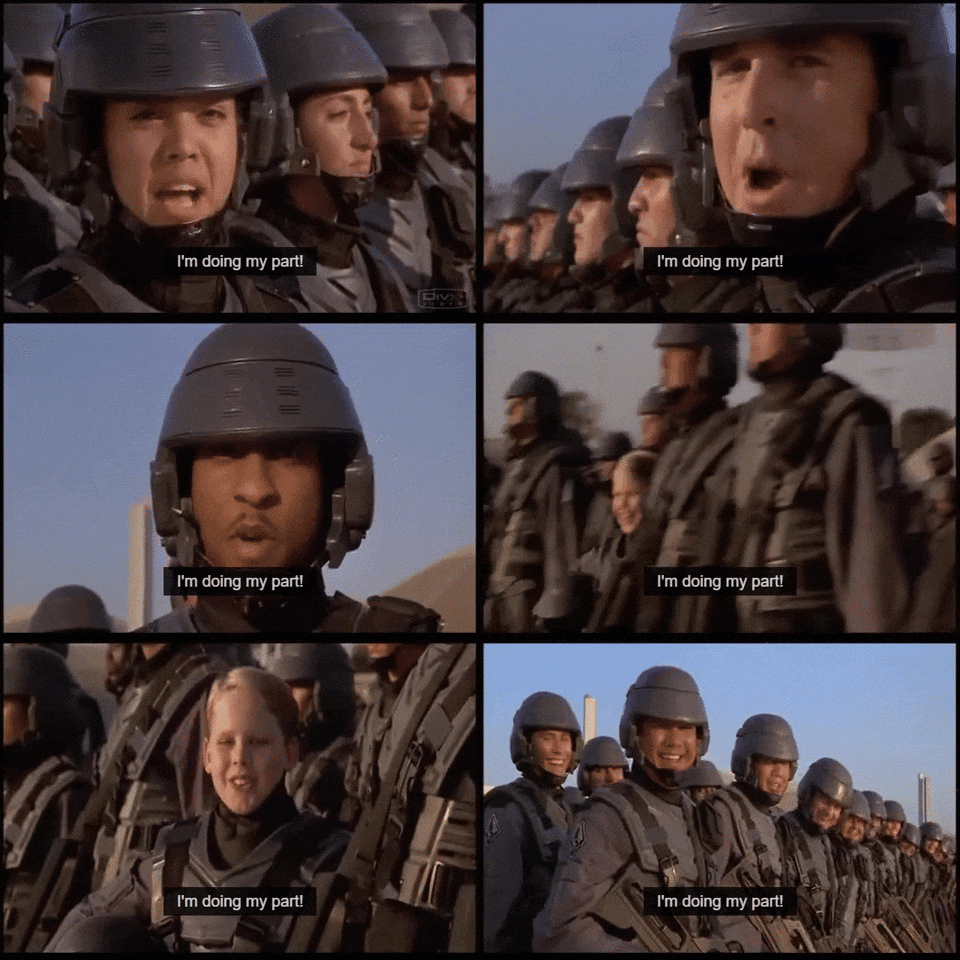
If we do not stop to help each other, what do we become?

Yesterday, I received this email as a response to You Can't Vibe Code Love. It's such a remarkable and powerful statement that I asked permission to share it here, in its entirety, with personal information redacted:


This is a companion discussion topic for the original entry at https://blog.codinghorror.com/if-we-do-not-stop-to-help-each-other-what-do-we-become/
2 Likes

Hello! Is anyone here anymore? Oh, what irony would it be, if this place had nobody to read this either. :sweat_smile:

I understand what you’re saying, and this got me thinking about the next question - “why?” Why are the online communities drying up? Why are we becoming more isolated? Is it really just the nefarious machinations of large corporations? Or is there something else?

Because to me it seems like… well, corporations DO affect the way the world is going, but they also are kind of… reactionary? Like, they don’t create new wants, needs and desires in people, they just take the ones that are already there and (ab)use them as much as they can. They give people what they want - and people just aren’t very good at wanting things which are good for them.

I’m thinking of other places where human contact has been slowly going away in my life. For example, in a supermarket I prefer to use a self-checkout. In McDonalds, I prefer to use the ordering kiosk. Because it feels more… relaxed. If I’m talking to another human, I feel the need to be quick and efficient and not waste their time. The machine doesn’t care though. Unless there’s a queue to use them, I can just take my time and move at my own pace.

And it’s similar when deciding to ask a question online. A chatbot is much faster and convenient, and you’re not imposing yourself on other people.

Another example - COVID gave a lot of people (especially us, software developers) the opportunity to work from home, and most people have become… quite attached to this arrangement. There is real resistance in going back to the office. And often it also works in the favor of companies, who can now downsize their offices. Not needing to commute is a really convenient time-saver, and also good for the environment. Plus it doesn’t really feel very isolating, unless you’re very extroverted.

And on topic of helping others, especially strangers - for a long time now I’ve marveled at how awkward it feels to give money to a beggar. It just feels… wrong, somehow. With my rational mind I can think this through - that 1 or 2 euros is not going to be a noticeable loss in my budget. I spend more on a whim when buying lunch or games on Steam. And it could make all the difference in the world for the person receiving. Or they could spend it on booze and drugs. But it would not be MY problem, it would not be MY choice. There’s no moral gray area here, as far as I can tell - giving is the right thing to do, period. And yet… why does it feel so wrong? Unusual.

Similarly for helping people online with what is obviously their homework. Is this someone who is genuinely struggling, and maybe doesn’t even know how to ask a good question; or is this someone lazy who wants others to do their work for them? If I tell them the answer, have I helped them to grow, or have I enabled them to avoid growing? Again - this shouldn’t be MY problem. But it feels like it is…

And so… I really don’t know. It’s easy to blame things on “the bad corporations”, like it’s easy to blame obesity on “super-palatable junkfood” - but at the heart of it, it’s our own bad choices. Corporations are just feeding into that and profiting off of it.

But what’s the fix? I don’t know…

2 Likes

That’s true, in the same way that getting addicted to heroin or gambling is a choice. Deciding to try a thing once feels like a low stakes choice, but our brains are so easy to reward-hack, especially when the daily life is full of drudgery and economic precarity.

And with junk food specifically, there’s a whole industry hooking kids on it. Like, it is absolutely mental to let a fastfood chain run a shool cafeteria, but that is a thing in the US.

2 Likes

Don’t worry, you are not alone. At least one more soul is still here, reading. Both of you raised brilliant points, so thought-provoking.

Never written here before, but inspired by Jeff’s message, made a small effort to sign up and reply.

3 Likes

Jeff,

Just wanted to say that Stack Overflow really helped me out when it first came out. I started reading your blog around 2008. I left the programming world in 2017 and started my own small business and no longer work in software, but I still really enjoy reading your blog.

1 Like

Yes, this… is an open question for me still. Where is that border between “you should have known better, this is your fault” and “you could not resist this and it’s not your fault”? When it comes to our own desires, what counts as being under our control (and thus our responsibility), and what doesn’t?

There’s madness on both ends of the scale - either you’re responsible for everything, including drug abuse; or for nothing, including the most grievous of crimes. You could argue, that you’re just a product of your specific circumstances - genetics/upbringing/experiences/etc - and thus have no real choice over your actions. Anyone in the exact same shoes as yours would have acted the same way. And you can also argue, that everything you do while being conscious is still a choice and thus you are fully responsible for it.

There is even a paradoxical (yet necessary) example from real life. We all know that a person under the influence of alcohol or drugs often is “less in control” of themselves. They do things that they normally wouldn’t if they were sober. However in a court being under influence makes you MORE guilty/responsible, not less. I understand why that is so, and I agree that the end result is correct, but… ehh… I can’t make it all make logical sense.

So, like… I don’t know. Do you have a nice, clear criteria how to determine what is under a person’s control (and responsibility) and what isn’t?

1 Like

I don’t think it’s about deciding what is a personal choice and what is not. Ultimately 1) nobody is a perfectly rational spherical being in a vacuum, 2) we should focus on what we can control.

Which is why to me, the point of having society is to make it easier for it’s members to make good choices. This is why I believe in Portugal-style drug decriminalization, and why I believe that eliminating food and housing insecurity world-wide is a topmost priority after combating the climate change.

Would there still be some violence if everyone had the same access to basic necessities, education, opportunities? Sure, personal conflicts happen. Would people make bad choices like operating dangerous machinery while under some form of temporary impairment, or going to a crowded space while sick? Sure. But it would be a lot easier to argue that those are *personal choices* than in the world where not going to work while sick means a risk of losing your income and going hungry, where organized crime may be the best employer around.

2 Likes

“There’s madness on both ends of the scale - either you’re responsible for everything, including drug abuse; or for nothing, including the most grievous of crimes.”

It’s exactly this type of black and white fallacy that by nature creates a form of madness and confusion. (not a dig at anyone, but an observation).

On one end of this argument is a system that is laissez-faire: the burden of morality and support is foisted on the individual (see: Tragedy of the Commons, carbon footprint, etc.). The individual is the layperson on this end. On the other end, the individual is the one to whom laws need not apply. We see both in tandem in the real world.

We’re in the realm of philosophy here where (as you touched on) one can study all the various schools of thought (i.e. nihilism, behaviorism, humanism, buddhism, taoism, biological markers, absurdism, jungian archetypes, freudian psychotherapy, internal family systems, ad absurdum) and yet can still not have an answer that feels satisfying in the general sense. I believe that this is because we’re operating at an improperly sufficient level of abstraction (i.e. the individual).

We as humans are tribal beings. As such, certain responsibilities are above the capability/capacity of the individual simple by scale. This is (supposed to be) why governments exist: taking problems that are too large and pooling the collective to share the load both cognitively and physically.

That’s not to say that one can, for example, efficiently feed every person in an entire country through a central entity. We saw this fail miserably through Mao’s banning of private farming and attempted centralization of agricultural planning and distribution (among other reasons like pulling farmers away from their farms etc., but talking about the nuance of why centralizing power as a whole is problematic is one for another day). Some tasks must occur through local governance/organization distributed across a larger system (think food banks dotted across the United States).

All of this to say, these problems contain problems at both the Macro and Micro scales. There are ways we as individuals can help (volunteering, connecting with and investing back into our communities, reducing reliance on corporate entities, etc.) and there are huge systemic issues with the way our society operates economically and socially that will take a lot of collective action to fix.

edit: formatting and grammer

1 Like

I am generally a proponent of local-first governance, but I am unconvinced that failures of Soviet and Chinese planned economies were entirely due to centralization. In my opinion the two faults were:

  1. the central government was almost entirely undemocratic, therefore planning for the wrong things (which can still happen at small scale)

  2. the technological deficiencies of the time period in gathering and processing of information additionally impaired centralized decision making

3 Likes

Absolutely. The planning being insular and undemocratic is a part of the centralization that I was referring to. (Death-By-Committee can definitely happen too, but again there’s plenty of nuance here to go around)

Juxtapose “The Great Leap Forward” failure to the US Postal Service as a cross-border nationwide entity managing local branches effectively at scale and I can totally agree that with the right technology, a federal entity can certainly operate successfully.

edit:

Hmm I see how my original point didn’t specify that I was thinking of the concept of “what if one state produced all the food in the entire United States”. It’s evidently more effective to provide guidance and oversight from a centralized authority when you distribute the production across the domain. Otherwise your supply chain becomes more expensive and for perishables like food that model breaks down “more easily” as time constraints are tighter.

1 Like

this is why we need a third place more than ever. Adults have work and home. Online communities used to act as a third place. With AI. In today’s world. We need a local offline third place for shared community.

2 Likes

i think radiohead did a cover about it see also the parable of Lazarus you can also try screaming for someone to call 911 in downtown chicago outside a university where 100% of the gen zs are wearing airpods and hate nothing more than making eye contact

2 Likes

I guess we don’t have to cede ground. Stack Overflow communities and questions still exist. We can choose to ask, and answer, questions there. We can choose human interaction over AI responses.

1 Like

It’s comments like this that makes me think that we in modern society are due a sort of social reckoning

Hmm, maybe reckoning is the wrong word, a reassessment, a rethinking, the enlightenment was so long ago, and yet our understanding of the world,our capacity to reason and manage ourselves despite it due to our best intentions and interests is better understood

I feel like we need to take the thoughts and understandings that we had of that time as well as others (for example the Romantic period) and rethink what we can do as people, individuals coming together to form a society and ask ourselves what it all looks like

Our social expectations haven’t changed

Humans are not suddenly different, but our world is so different and we understand ourselves better than we did before

Doing the hard work of trying to understand what that means and how we can go about creating a world that better enables all of us would be a worthy endeavour


I’m confused, what do you think Walmart does? Or Starbucks? Are you saying that it’s inconceivable to believe that the techniques they and other similar entities employ means that we couldn’t build something in society that just provides simple and healthy meals for everyone at cost or cheaper?

I know that when I bulk cook I can get to silly numbers for good food, heck soup kitchens can do pretty well too, the problem is that a soup kitchen isn’t a socially free space, it’s not like a library, using it imbues some sort of social tarring, making you lesser in the eyes of others

If it was just another place to eat, similar to a library, we’d have a lot less food insecurity I’d wager, not none mind, but less, we would probably have to do more, similarly for simple shelter

We’re stuck relitigating the past when anyone who’s built a startup knows sometimes failures are because the idea is bad, and other times, it just needed to be worked on more, or the “market” wasn’t ready

You can’t invalidate a concept just like that, just changing around a few things could make it work, and I don’t know about you, but removing these specific kinds of suffering from the world, not to mention the many people who will do literally anything not to experience them, would I suspect remove a great deal of ill from the world

Our social contract is looking more and more broken every day, we really should work out how we can fix it


Separately, thanks Jeff, if you’re reading this, stackoverflow was a wonderful contribution to the world, I personally found it helped me so much and especially in the early days encouraged me to contribute and help others out

So thank you for your efforts in bringing it to the world

1 Like

In the early 2000s , I was “kinda” a popular kid. I was always in touch with many friends, and used to receive and make many phone calls and send alot of messages, specially on holidays or national occasions (where I live there’re many).

Where I live people receive alot of message on occasions so it’s not a big deal. But for some reason, and unlike most of my friends, every-time I sent a message I was getting happy remarks or calls!

I did not know why until a friend told me that “your messages screams I just wrote this for you” , it was not a copy-paste or a template message meant for everyone. Unlike others, your messages had details or funny gestures about something we share.

Now nearing my 40s and I still think about it. There’s something about knowing that someone cared enough to spare time and make an effort.

I know there’re many grammar mistakes in this comment/message, and I know I can correct it using LLMs, but I don’t want to. I choose to be authentic, I choose to be human!

2 Likes

In both the Soviet and Chinese Communist regimes, the lust for power (& absolute control of the masses) and massive corruption siphoned most of the money from government-funded projects. When, for example, $100M was allocated for a project, bribes/kickbacks took a major share of the funds. By the time a project reached sub-contractors, so little money was left the sub-contractors were forced to use inferior materials to keep from losing money. China was worse than the USSR, developing what is now known as “Tofu Dreg” construction - with bridges, dams, apartment towers collapsing, sometimes within months (instead of 50-100 years). Bangkok found this Tofu Dreg construction the hard way with a Chinese-built apartment tower being the only one to collapse during an earthquake.

The Soviets’ 5-year plans were unrealistic, especially given the inhuman treatment the leaders imposed on the Russian people (labor camps/death camps/torture) to achieve impossible goals.

I think in both the Soviet & Chinese governments there was a lot of information manipulation - and telling the top brass what they wanted to hear instead of informing of problems/failures which would (hopefully) lead to revisiting the projects and coming up with real solutions. Also, the lack of valuing human life in both countries was corrosive. It’s no small wonder that in both countries, what was instrumental in their achieving greatness was mostly stolen from Western countries.

Ouch! Walmart is a very poor example. Before Walmart there were countless Mom & Pop grocery/small department stores and a thriving community. Enter Walmart: Undercut the Mom & Pop stores, forcing them to shut down. Many, if not most Walmart employees are dependent upon government-/taxpayer-funded social services to survive. Yes, Walmart is now the largest private employer in the US, but the employees are not the beneficiaries. Imagine how much taxpayer money could be freed up for other services if Walmart actually paid a living wage to its employees.

A good many people (majority?) do actually take the time to help others. This may just be our saving grace.

That’s what I’ve always tried to do with Christmas cards, birthday cards, sympathy, and the occasional “Just a note” cards - write an individual note to each recipient. Even the individual cards were hand selected for each recipient. We used to send out 45 Christmas cards plus 3x the number of birthday/anniversary cards. (Both my & I are from large families.) Our local Post Master jokingly asked if we were trying to keep the PO in business.

Here, here! I agree 100%! It’s one thing to “polish” an essay you’ve written yourself, and another thing to post a “polished” essay by a LLM/AI bot. I prefer the DIY version.

1 Like

To further expand on Jim’s point, it’s not that entities like Walmart or Starbucks don’t operate at scale across large regions. The argument we’re focusing on here is for removing food insecurity with free food, or rather with food paid for by the taxpayer. As I mentioned in my followup comment, a centralized authority is distinctly different from centralized production.

Are you saying that it’s inconceivable to believe that the techniques they and other similar entities employ means that we couldn’t build something in society that just provides simple and healthy meals for everyone at cost or cheaper?

These things all come at a cost. For companies like Walmart or Starbucks it’s all part of their business model to utilize, instigate, and perpetuate supply chains that prey on and exploit the labor of those producing the food. Coffee and Cacao are excellent examples of exactly this where a 50lb bag of green coffee beans are purchased for pennies on the dollar. Peruvian and Bolivian exports of quinoa also comes to mind where the QoL of many of the farmers was claimed to have been increased monetarily but again that also came at a cost, chiefly, over-farming and no guarantee that the wealth was/is distributed fairly across the supply chain [1].

Additionally, McDonald’s and Walmart own effectively every aspect of their own supply chains so the fluctuation of the market does not affect them in the same way, yet they use publicly funded roads for transportation and rely on food stamps to prevent their employees from starving on the pittance they pay out in wages.

As for providing simple healthy meals for everyone at cost or cheaper, there are already stores that do that for military families [2]. It’s certainly possible (as we’re also seeing in New York currently).

I would be thrilled for more of my tax money to go towards reducing food insecurity, prioritizing multi-family housing development, and reliable public transit (i.e. high speed rail, carless cities with bikeable/walkable/subway infrastructure, etc.).

The point is not to invalidate any of these efforts but instead to highlight problems that sound reasonably simple and straightforward to solve when viewed through certain operating models but which require different solutions when implementing them through profitless and morally-improved models.

If it was just another place to eat, similar to a library, we’d have a lot less food insecurity I’d wager, not none mind, but less, we would probably have to do more, similarly for simple shelter to eat, similar to a library, we’d have a lot less food insecurity I’d wager, not none mind, but less, we would probably have to do more, similarly for simple shelter

I see videos of this in countries where someone cooks meals for large swaths of people. Churches have also been the entities to do this for centuries (albeit often at the price of piety). It brings up a good point though perhaps echoing “no such thing as a free lunch” where contribution back is expected. But who does that leave behind? Are taxes not enough of a contribution? I suppose as long as it’s not contingent on citizenship or labor ala meritocracy. Aaaannd now I’m thinking of starship troopers lol

giphy(2)

I think the bigger border is what lies between, “it doesn’t matter what you did” and “it matters what you did and something needs to change.”

The other day I just happened to be reading, “Power Buys You Distance From The Crime”:

Or take slavery. No company goes “I’m going to go out and enslave people today” (especially not publicly), but not paying people is sometimes cheaper than paying them, so financial pressure will push towards slavery. Public pressure pushes in the opposite direction, so companies try not to visibly use slave labor. But they can’t control what their subcontractors do, and especially not what their subcontractors’ subcontractors’ subcontractors do, and sometimes this results in workers being unpaid and physically blocked from leaving.

Who’s at fault for the subcontractor(^3)’s slave labor? One obvious answer is “the person locking them in during the fire” or “the parent who gives their kid piecework”, and certainly it couldn’t happen without them. But if we say “Nike’s lack of knowledge makes them not responsible”, we give them an incentive to subcontract without asking follow up questions. The executive is probably benefiting more from the system of slave labor than the factory owner is from his little domain, and has more power to change what is happening. If the small factory owner pays fair wages, he gets outcompeted by a factory that does use slave labor. If the Nike CEO decides to insource their manufacturing to ensure fair working conditions, something actually changes.

…Unless consumers switch to a cheaper, slavery-driven shoe brand.

That asks the question: a frequent answer is given by Milton Friedman:

There is one and only one social responsibility of business - to use its resources and engage in activities designed to increase its profits…¹

Our particular form of corporation, including its ownership (by those who supplied the capital, only, with generally no voice by most of those who work in it—particularly doing nasty things for it), its responsibilities (not for everything it does but only for a few things specifically enumerated, and often not even for all of those), and the completely lack of responsibility attributed to the owners, is a huge part of the reason so much misery is created in the world.


¹ Yes, I know he goes on about “within the rules” and all that. And we also well know that a) he proposed an extremely limited set of rules, so limited it could clearly produce social ills; b) rules aren’t always followed, c) rules often fail to produce desired results even if followed.) If your aims are wrong, no set of rules is going to fix those aims.